Best Practices for Using Prepaid Restaurant Deals in India Without Misreading the Savings
Checking prepaid deal terms on EazyDiner before committing to payment
26 Nov, 2026 by Editorial Team
A prepaid restaurant deal showing 50 percent off can feel like a windfall, until the bill arrives and the savings look nothing like what was promised. Diners across India increasingly turn to prepaid dining deals on EazyDiner to lock in discounts before they eat. Yet the gap between the advertised number and the net saving on the final bill catches many people off guard. Understanding how prepaid deals actually work, and what to check before paying, separates a genuinely smart booking from an expensive misunderstanding.
TL;DR - Summary
- What are prepaid dining deals?
Prepaid dining deals let diners pay a fixed amount in advance through EazyDiner and receive a discount or credit at a partner restaurant. The discount applies to specific menu items or total bill thresholds, not necessarily to every item ordered.
- Why do diners misread the savings?
Headline discount percentages often apply only to the food bill before taxes, service charges and drinks. Diners who assume the percentage covers the entire spend end up overestimating what they save.
- How to calculate net savings?
Subtract taxes, service charges and any excluded items from the total bill first. Apply the prepaid discount only to the eligible portion. The result is the actual rupee amount saved, which is often lower than the headline figure suggests.
- When should you use prepaid deals?
Prepaid deals tend to deliver the best value on weekday dinners, larger group bookings and restaurants where the food bill forms a high share of the total. Weekend or holiday restrictions can reduce or void the discount entirely.
- Does EazyDiner help clarify terms?
EazyDiner lists deal inclusions, exclusions, validity windows and restaurant-specific conditions on each prepaid offer page, giving diners the details needed to judge real savings before committing payment.
How prepaid deals work
A prepaid deal on EazyDiner follows a straightforward sequence. The diner selects a restaurant, reviews the deal terms and pays a discounted amount in advance. At the restaurant, the prepaid credit is applied against the eligible portion of the bill. The restaurant honours the deal because EazyDiner has already settled the transaction.
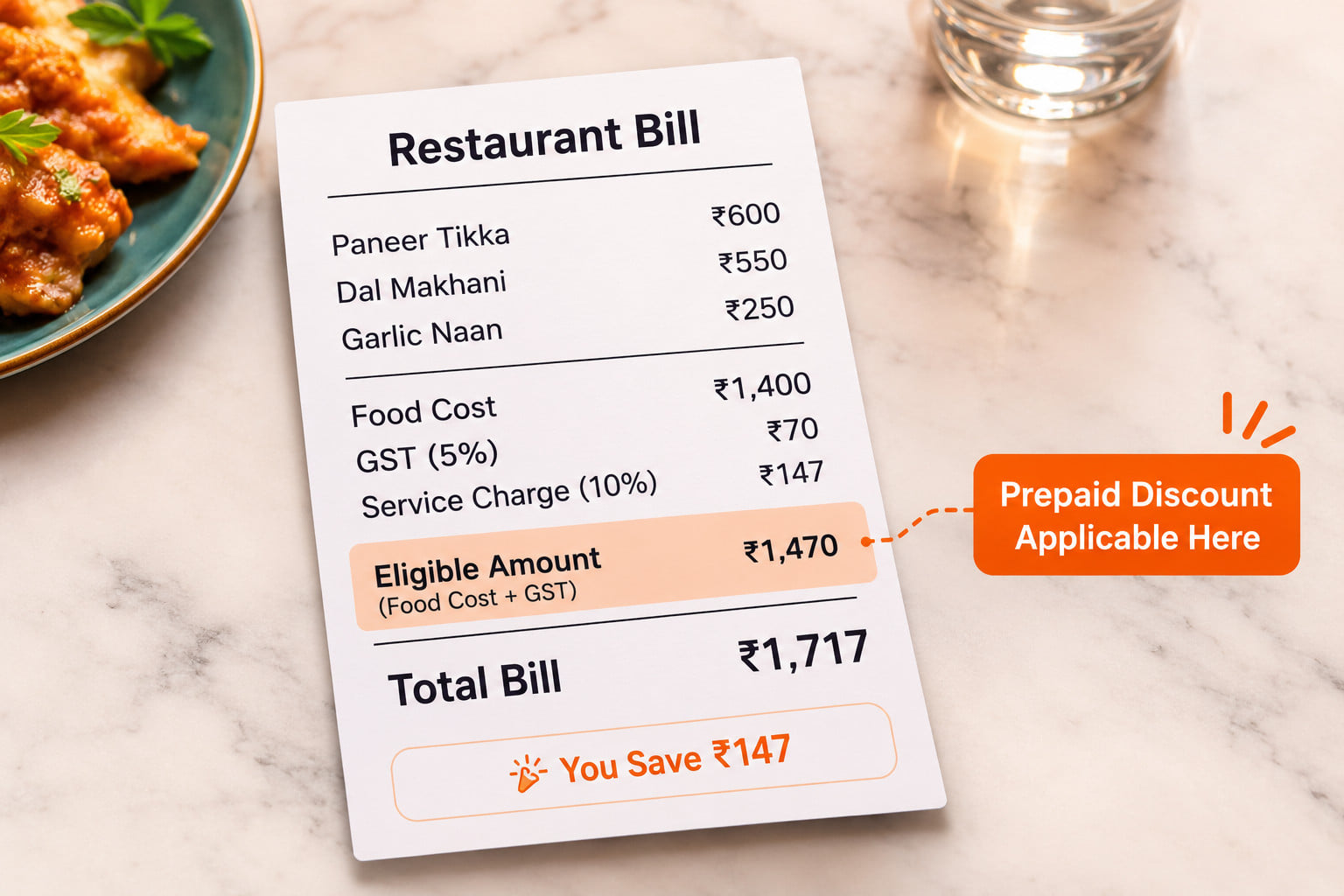
The critical word in that sequence is "eligible." Not every line item on a restaurant bill qualifies. Alcoholic beverages, imported ingredients, special tasting menus and live entertainment surcharges are commonly excluded. Taxes and service charges almost always sit outside the discount calculation. Recognising these boundaries before paying is the single most important step a diner can take.
Why headline discounts mislead
A deal labelled "40 percent off" can suggest that a ₹3,000 dinner becomes ₹1,800. In practice, the arithmetic rarely works that way. The 40 percent typically applies to the food component alone, before GST and service charge are added back.
Consider a meal where the food bill is ₹2,000, drinks are ₹600 and taxes plus service charge total ₹400. The 40 percent discount applies to ₹2,000, saving ₹800. The final outlay is ₹2,200 against a full price of ₹3,000. The effective saving is closer to 27 percent, not 40 percent. Diners who budget based on the headline number end up spending more than planned.
EazyDiner addresses this by listing what the discount covers on each deal page. Reading that breakdown before checkout is a habit that can prevent billing surprises at the table.
Best practices for prepaid deals
1. Read the inclusions first
Before tapping "Pay now," scroll to the deal's terms on EazyDiner. Check whether the discount covers only food, or food and soft beverages. Note any minimum bill thresholds. A deal requiring a minimum spend of ₹2,500 offers no benefit on a light lunch for two.
2. Calculate in rupees, not percentages
Convert the percentage into an actual rupee figure based on what you plan to order. A 50 percent discount on a ₹1,000 food bill saves ₹500. A 25 percent discount on a ₹4,000 food bill saves ₹1,000. The lower percentage can deliver higher absolute savings when the base spend is larger.
3. Check validity windows
Many prepaid deals on EazyDiner are valid only on specific days or during certain hours. A weekday lunch deal used on a Saturday may not be honoured. Confirm the validity window matches your planned visit before completing payment.
4. Factor in taxes and charges
Add GST (typically 5 percent for restaurants without air conditioning, 5 percent for those with) and any service charge the restaurant applies. These amounts are payable on top of the discounted food bill. Including them in your mental budget gives a realistic picture of the final spend.
5. Match the deal to your group size
Prepaid deals can work well for groups of four or more because the food bill tends to be high relative to fixed charges. For a solo diner or a couple ordering lightly, the minimum spend threshold may force unnecessary ordering. EazyDiner shows the minimum bill requirement upfront, so diners can judge fit before committing.
6. Use deals for planned meals
Prepaid deals reward planning. Impulse purchases, where a diner buys a deal without knowing the restaurant's menu or price range, carry the highest risk of mismatched expectations. Browse the restaurant's menu on EazyDiner, estimate the food bill, then decide whether the deal genuinely reduces the cost of what you would have ordered anyway.
7. Watch for stacking restrictions
Some restaurants do not allow prepaid deals to be combined with credit card offers, bank promotions or EazyDiner Prime membership benefits. Attempting to stack discounts at the table can lead to confusion and delays. EazyDiner notes stacking restrictions in the deal terms. Reading those terms avoids an awkward conversation with the restaurant manager.
When prepaid deals deliver real value
Prepaid deals on EazyDiner tend to deliver the strongest net savings in specific scenarios. Weekday dinners at mid-range restaurants, where the food bill dominates the total, offer the cleanest discount arithmetic. Group celebrations, where a large food order easily clears minimum spend thresholds, also benefit. Restaurants running seasonal or festival promotions through EazyDiner sometimes offer deeper discounts than their standard menu pricing, making the prepaid route genuinely cheaper than walking in without a deal.
Conversely, prepaid deals may offer limited value at fine dining restaurants where drinks, wine pairings and tasting menus form a large share of the bill. The discount applies to a smaller base, and the excluded items push the total higher than expected. Recognising this pattern helps diners choose deals that align with their actual dining style.
How EazyDiner supports transparency
EazyDiner structures each prepaid deal page to show the discount percentage, the eligible bill components, the validity period, the minimum spend requirement and any stacking restrictions. This layout is designed to help diners assess net savings before payment, not after. The platform also displays restaurant ratings, cuisine type and location details, so diners can evaluate whether the restaurant itself suits their occasion.
For diners who eat out frequently, EazyDiner Prime membership can unlock additional prepaid deal tiers and member-only offers. The membership page on EazyDiner lists the specific benefits and pricing, allowing prospective members to judge whether the annual cost is justified by their dining frequency.
Treating prepaid deals as a budgeting tool rather than a blanket discount is the mindset shift that separates satisfied diners from frustrated ones. The savings are real, but only when the diner reads the terms, does the arithmetic and picks deals that match what they were already planning to spend. EazyDiner provides the information needed to make that judgement. The diner's job is to use it.