
Tête-à-Tea with Sachin Pabreja: In Conversation With Chef Osama Jalali & Founder Smriti Agrawal, On the Soul and Story Behind At Majlis
Two founders, one shared table and a story worth telling
17 Jan, 2026 by Sachin Pabreja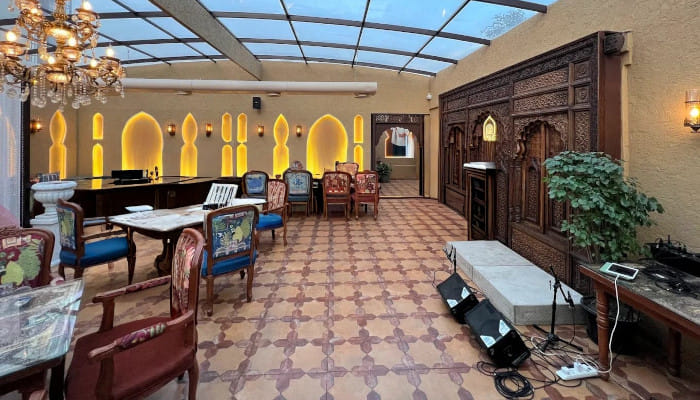
At Majlis is more than just a restaurant; it’s a space built on stories, shared meals, and a deep love for culture-led cuisine. At the heart of it are two passionate forces: Chef Osama Jalali, known for his thoughtful, soulful food, and founder Smriti Agrawal, whose vision brings warmth and purpose to every corner of the space. In this conversation, they open up about the journey behind At Majlis, the ideas that shaped it, and what it truly takes to build a restaurant that feels like home.
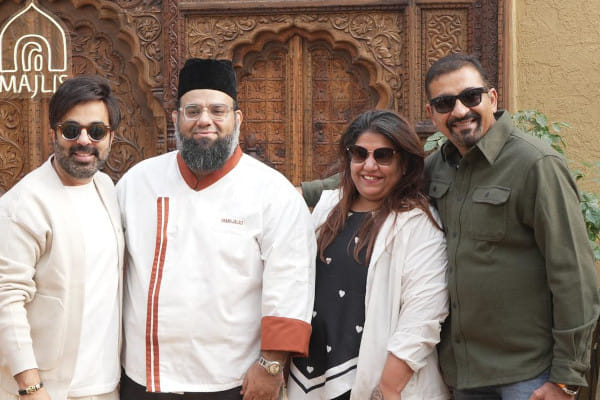
1. Chef Osama and Smriti, At Majlis is poetically called a "time machine" to India's imperial kitchens. What was the spark that brought you both together to create this regal revival in Noida – was it a shared meal, a family story, or a dream over chai?
Smriti Agarwal: It was less a spark, more a slow-burning longing, a desire to bring back the poetry of a time where food was ritual, not routine. I had followed Chef Osama’s journey for years; his meticulous work reviving lost recipes, his ability to make even the simplest dish feel like an inheritance. His food didn’t speak, it whispered.
When we met, there was instant resonance. I had always dreamed of a space where the spirit of Noor Jahan’s court could breathe again, not as an imitation, but as an experience. Where the rustle of a dastarkhwan, the scent of saffron, the silence before a daawat would awaken forgotten senses. At Majlis was born not of trend, but of reverence, for legacy, for forgotten flavours, and for the quiet grandeur of India's imperial kitchens.
Chef Osama: Smriti didn’t just see food as consumption; she saw it as culture. That’s rare. I’ve spent years in pursuit of recipes that history has almost swallowed, scribbled notes from khansamas, oral traditions passed through generations. When Smriti said, “Let’s not just serve a meal; let’s serve memory,” I knew this was more than collaboration. This was a calling.
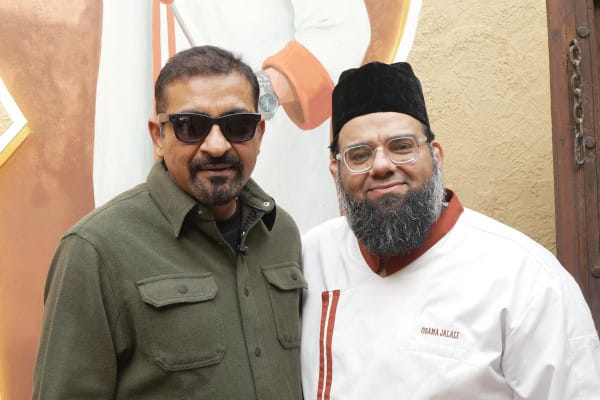
2. Chef Osama, you've been hailed as the guardian of lost Mughal and Nawabi recipes from your Rampuri roots and Old Delhi upbringing. Share a childhood memory of a dish from your mother's kitchen that you absolutely had to revive at At Majlis – one that transports you back every time you cook it.
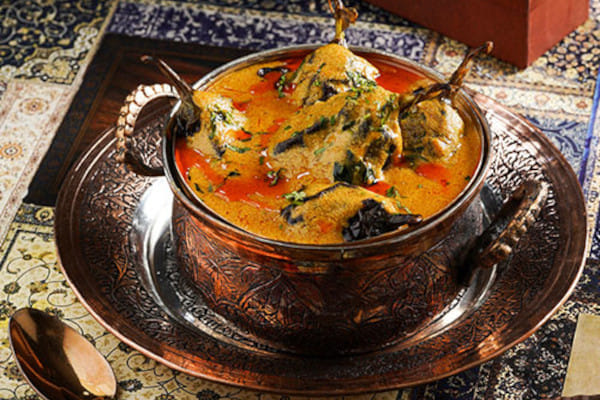
Chef Osama: I grew up in a household where recipes weren’t written, they were whispered, adjusted by intuition, perfected by touch. One dish that stayed with me, stitched into the fabric of my childhood, was Murgh Zafrani Qorma. It was elegant, never loud, fragrant with saffron, softened with slow-cooked onions, and touched with the grace only a mother’s hand could give. I remember sitting in our Old Delhi home, the aroma of that qorma rising from the sigdi as my mother stirred gently, tasting with her eyes closed. She didn’t cook with timers; she cooked with emotion. Reviving that dish at At Majlis wasn’t just about getting the flavour right; it was about restoring the memory. Every time I prepare it, I’m not just a chef, I’m a son, back in his mother’s kitchen, learning that food, when done right, can be a form of love.
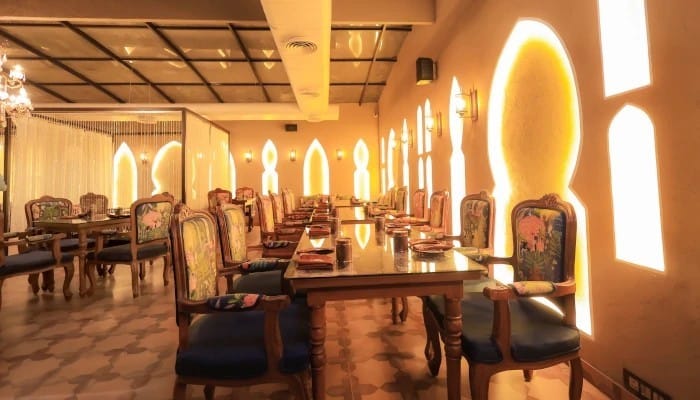
3. Smriti, the interiors at At Majlis – with reclaimed Mughal doors, antique marble, flowing drapes, and art collaborations with Jamia students – feel like stepping into a Sultan's palace. What inspired this immersive design, and how did you blend history with modern comfort to make guests feel like royalty?
Smriti Agarwal: I’ve always believed that spaces, like stories, should transport. The vision for At Majlis was never to create a replica of the past; it was to resurrect its essence. I wanted guests to feel what it must have been like to dine under the gaze of Noor Jahan’s chandeliers, where the clink of ceramic was the only sound, and conversation unfolded like poetry. We travelled across the country sourcing reclaimed Mughal doors, antique marble slabs, and textiles dyed in natural hues of charcoal, terracotta, and ivory. The soft drapes aren’t just aesthetic; they’re intentional. They create hush, intimacy, the kind of silence that lets aromas speak.
Bringing in students from Jamia to reinterpret Mughal motifs was one of the most meaningful choices. They didn’t just paint, they reimagined. Their youth brought freshness to centuries-old forms. At Majlis is, after all, a dialogue between then and now, a place where legacy is passed down, not locked away.
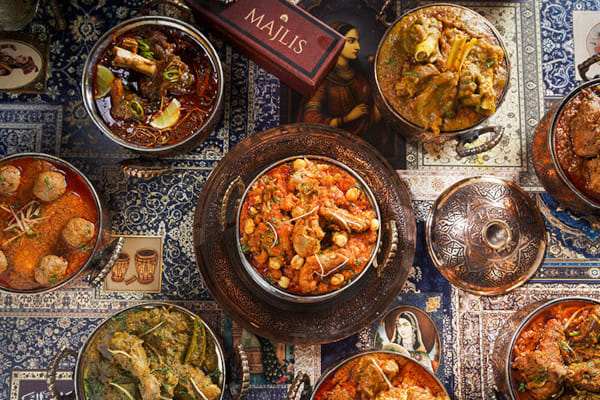
4. The dining ritual at At Majlis starts with a traditional hand wash and unfolds like a royal daawat on Kashmiri ceramics. Walk us through a perfect evening there – what's that one moment when guests realise they're not just eating, but experiencing history?
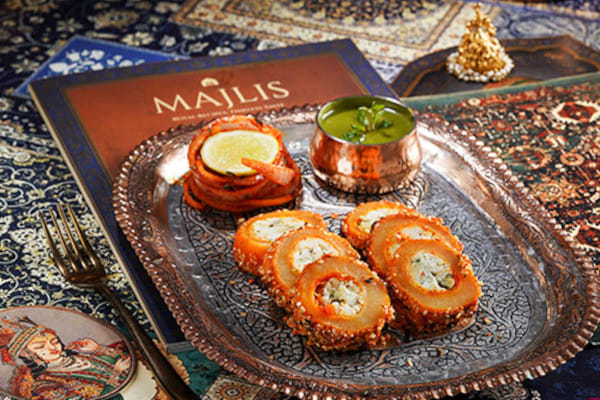
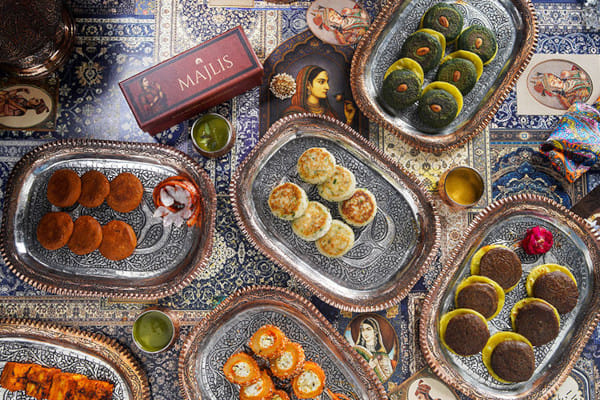
Chef Osama: It begins the moment they’re seated. A copper basin is brought forth for the hand wash, an act not of luxury, but of respect. It’s a gesture from another era, one that sets the tone for everything that follows. Then comes the unfolding of the dastarkhwan, the cloth laid across the table, the stage for a performance that spans centuries. Dishes are served in handmade Kashmiri ceramics, each one selected not just for form but for feeling.
The moment it all comes together is quiet. It’s when a guest takes a bite, say, of Kebab e Burrah or Taar Gosht, and they pause. Their eyes close, a memory flickers, though they may not even know what it is. That’s the alchemy we aim for. The realisation that this isn’t a restaurant. This is a portal.
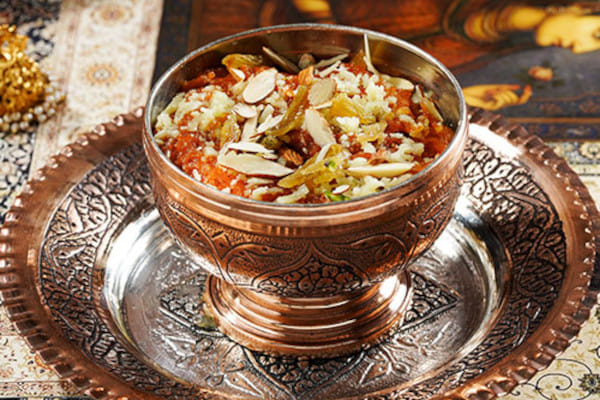
5. Chef Osama, influenced by the ancient Silk Route, your menu fuses Persian and Central Asian touches with Mughal classics. If you had to pick one "folklore on a plate" dish that every first-time guest must try, what would it be – and what's the secret story behind its revival?
Chef Osama: Without doubt, Gosht Halwa. It’s not a loud dish. It doesn’t come screaming with spice. It arrives like a secret, whispered through cashew paste, clarified butter, and the perfume of green cardamom. This was a dish once reserved for imperial courts, served in gold-lined bowls to queens like Noor Jahan. I found its mention in a rare Persian cookbook from the Sultanate era, then discovered a variant in my own Rampuri family archives. It was never meant to be rushed; it needs time, silence, and reverence. At At Majlis, we revived it using age-old techniques: slow-simmering the meat till it sighs off the bone, grinding the almonds by hand, layering the dish with the kind of finesse only patience allows. It’s not just a dish, it’s a sonnet written in saffron and silk.
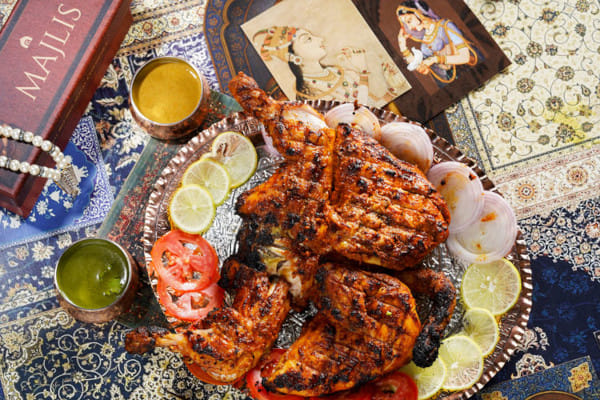
6. In a world obsessed with quick trends and fusions, At Majlis stands firm on authenticity and slow-fire cooking. How do you both resist the temptation to "modernise" recipes, and what's the funniest or most surprising guest reaction when they taste the real, unfiltered flavours?
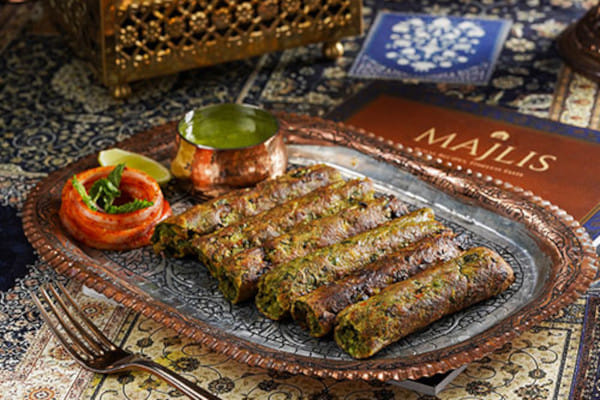
Chef Osama: Trends are gusts of wind. Heritage is the mountain. When you’ve inherited a tradition as nuanced as Mughal cuisine, you don’t need to reinvent it; you need to restore it with reverence. Our dishes are not manipulated for mass appeal. They are presented in the exact spirit in which they were first born. Once, a guest asked why our kebabs weren’t paired with cheese or truffle oil. I smiled and said, “Because they were never meant to be.” But minutes later, after the first bite of our Shaami Kebab, they looked up and said, “I’ve never tasted silence before.” That, to me, was everything. The flavours don’t shout, they remember.
Smriti Agarwal: Staying rooted in authenticity isn’t resistance, it’s respect. Our job is not to modernise the recipe, but to modernise the experience. The linen, the lighting, the art, they bridge the gap between then and now, so the flavours can arrive, unfiltered, in today’s world. That’s our quiet rebellion.
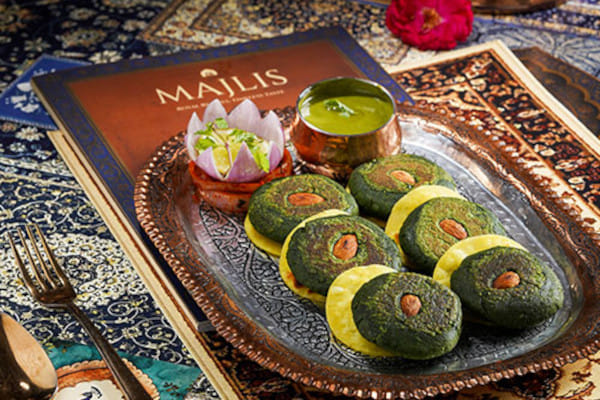
7. Smriti, collaborating with young artists from Jamia to reimagine Mughal motifs on the walls, adds such a living, contemporary soul to the space. How did this partnership begin, and what does it mean to you to bridge generations through art and food?
Smriti Agarwal: I’ve always believed heritage should never sit still; it should evolve through the hands of the next generation. Partnering with Jamia Millia Islamia’s art students was a deeply intentional choice. I didn’t want the walls of At Majlis to be static décor; I wanted them to be conversation pieces. I had worked with these students for At Live Cafe, but the work was more contemporary; their passion & talent drove me back to them for a perfect Mughal era. I envisioned a royal experience with royal recipes with nothing less than art & archival. I gave these young artists historical references, paintings, motifs, and textiles and asked them to respond, reinterpret, and recreate. The results were astonishing. They didn’t just replicate, they infused these forms with fresh eyes, giving birth to living tradition.
8. Chef Osama, you've curated global festivals and fed everyone from state heads to families. What's the most heartwarming feedback you've received at At Majlis so far – a story that made you think, "Yes, this is why we do it"?
Chef Osama: One evening, an elderly couple came in with their grandchildren. After the meal, the grandmother held my hand and said, “You’ve brought back a taste I thought I’d never experience again, not since my mother’s table in pre-partition Lahore.” She was in tears. Not because the food was spicy or sensational, but because it was familiar, in the most sacred way. That moment reminded me why I do this. At Majlis isn’t about impressing people, it’s about reuniting them with a memory they didn’t know they missed.
9. Running a heritage-focused fine-dining spot in fast-paced Noida must have its challenges – from sourcing rare ingredients to teaching the team ancient techniques. What's been the toughest hurdle you've overcome together, and how did it make At Majlis stronger?
Smriti Agarwal: The greatest challenge is not logistical, it’s philosophical. Convincing people to slow down, to savour, to be present. We’re in an era where food arrives in five minutes. At At Majlis, some dishes take five hours. The initial temptation was to adapt, to rush. But we stood firm.
Chef Osama: Training the team was another mountain. You don’t just teach recipes, you pass down culinary rituals. From roasting spices till the right crackle to understanding the silence of a simmer, it’s an art form. But once our team embraced it, they too became keepers of this flame. Those challenges only fortified us. They reminded us why we exist, to offer something that isn’t fast, but forever.
10. At Majlis isn't just about food; it's about silence speaking, aromas guiding, and leaving guests "moved." How do you hope this experience changes people's relationship with Indian cuisine in everyday life – perhaps inspiring them to cook a lost recipe at home?
Chef Osama: My hope is that guests walk out with more than a satisfied palate; they leave with a question: “What did my ancestors eat?” That curiosity is the seed. If it leads them to call their grandmother, dig out an old notebook, or try their hand at a lost recipe, then we’ve done our job.
Smriti Agarwal: I want people to see Indian cuisine not just as delicious, but divine. Sacred. Layered with politics, poetry, and power. Our food is not one-dimensional. It’s a thesis, a love letter, a rebellion. If At Majlis sparks a little more respect for it in the everyday kitchen, that’s a revolution in itself.
11. Looking ahead, with At Majlis already being called a prophecy for preserving forgotten flavours, any exciting plans like seasonal daawats, new revived dishes, or even taking this regal experience beyond Noida?
Smriti Agarwal: Absolutely. The response has been overwhelming, and it has only deepened our responsibility to take this mission further. We’re working on seasonal daawats, each celebrating forgotten regional feasts. Have celebrated folk music from different states with their pop-up menus with home chefs in my other restaurant, At Live Cafe. The plan is to replicate a 2.0 version with different state food festivals with their own instrumentalists (by the way, we have already covered a Kashmiri folk Santoor player At Majlis.) As for beyond Noida, yes, I dream of taking At Majlis to cities that crave authenticity. But we’ll never expand fast. We’ll expand faithfully.
Chef Osama: I’ve uncovered recipes from Bengal’s Nawabi circuits and Kashmir’s lesser-known royal kitchens. They deserve the spotlight. From Hyderabadi Yakut Mahal platters to Rampuri winter thalis, there’s so much waiting to return.
12. Finally, a fun one: If you could host a dream majlis at the restaurant with any historical figure from the Mughal or Nawabi era – say Akbar, Noor Jahan, or a legendary khansama – who would it be, what would you serve them, and what one question would you ask?
Chef Osama: Noor Jahan, without question. A woman of intellect, elegance, and extraordinary culinary sensibility. I’d serve her Gosht Halwa, slow-cooked as it was once in her court, paired with Sheermal baked over charcoal. And I’d ask her: “What was your philosophy behind dining, was it power, was it poetry, or was it something only you knew?” I believe her answer would echo in the very walls of At Majlis.
Smriti Agarwal: Akbar, hands down. Design a special Akbar Thali consisting of some of our vegetarian dal, sabzi, and roti, as some of our recipes are inspired by his kitchen. One question - when will he visit again with his nine gems? Have been inspired by his court, where art, intellect, administration, music, and wisdom thrived together.
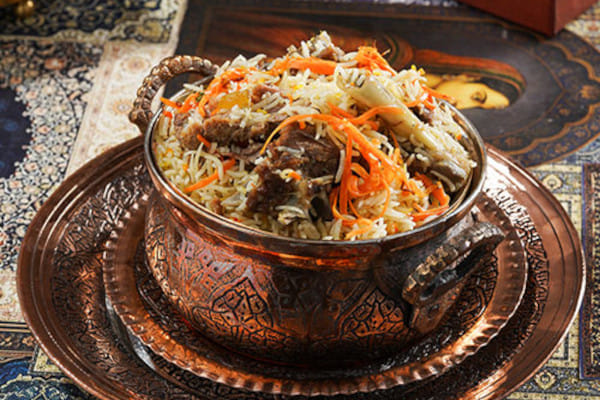
13. What inspired this immersive design, and how did you blend history with modern comfort to make guests feel like royalty?
Smriti Agarwal: I’ve always believed that spaces, like stories, should transport. The vision for At Majlis was never to create a replica of the past; it was to resurrect its essence. I wanted guests to feel what it must have been like to dine under the gaze of Noor Jahan’s chandeliers, where the clink of ceramic was the only sound, and conversation unfolded like poetry.
I travelled across the country sourcing reclaimed Mughal doors, antique marble slabs from Makrana, copper Kashmiri crockery and textiles dyed in natural hues of charcoal, terracotta, and ivory. The soft drapes aren’t just aesthetic; they’re intentional. They create hush, intimacy, the kind of silence that lets aromas speak.
Bringing in students from Jamia to reinterpret Mughal motifs was one of the most meaningful choices. They didn’t just paint, they reimagined. Their youth brought freshness to centuries-old forms. At Majlis is, after all, a dialogue between then and now, a place where legacy is passed down, not locked away.
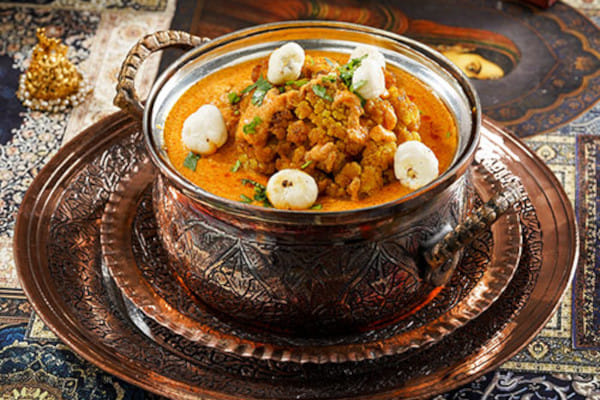
14. The dining ritual at At Majlis starts with a traditional hand wash and unfolds like a royal daawat on Kashmiri ceramics. Walk us through a perfect evening there – what's that one moment when guests realise they're not just eating, but experiencing history?
Smriti Agarwal: It begins the moment they step into At Majlis. A hand-painted portrait of Noor Jahan, India’s forgotten culinary queen, greets you in silence. No labels. No introduction. Just presence — regal, poised, enigmatic. As soon as you step in, a copper basin (tasht-e-naari) is brought forth for the hand wash, an act not of luxury, but of respect. It’s a gesture from another era, one that sets the tone for everything that follows.
Then comes the unfolding of the dastarkhwan, the cloth laid across the table, the stage for a performance that spans centuries. Dishes are served in hand-engraved Kashmiri copper crockery, each one selected not just for form but for feeling. The moment it all comes together is quiet. It’s when a guest takes a bite, say, of Kebab e Burrah or Taar Gosht, and they pause. Their eyes close, a memory flickers, though they may not even know what it is. That’s the alchemy we aim for. The realisation that this isn’t a restaurant. This is a portal.
Written By

A hotelier and restauranteur with more than two decades of experience in the F&B and Hospitality industries, Sachin Pabreja is Co-founder of EazyDiner, India’s only instant table reservation platform. He is passionate about changing the landscape of the Indian F&B industry. Prior to EazyDiner, Sachin worked at The Imperial, Grand Hyatt as well as Claridges Hotel in New Delhi and remains focussed and committed to creating innovative and exceptional products in the F&B and Hospitality industries.