Best Practices for Comparing Dining Payment Offers by Final Bill Impact, Not Partner Count
Focus on what you actually save, not how many partners are listed
27 Nov, 2026 by Editorial Team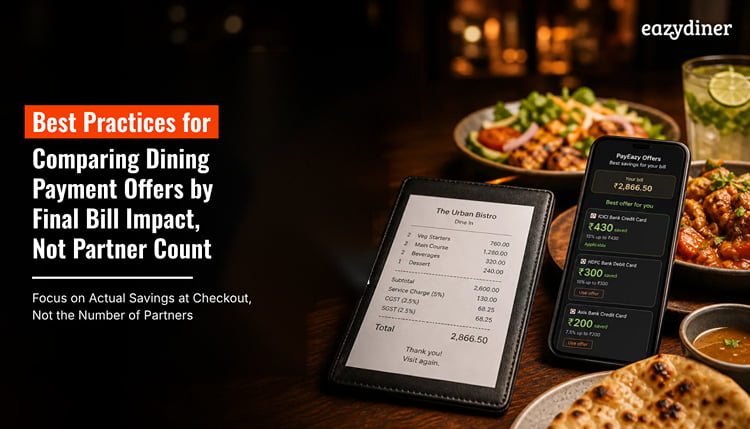
Most dining payment offer pages in India lead with a wall of bank and card partner logos. The assumption is that more partners means better value. But a diner planning a weekend meal for four does not need to know how many banks participate. That diner needs to know how much less the final bill will be. EazyDiner, through its PayEazy checkout feature, centres the conversation on actual savings at the table, not on the length of a partner list.
TL;DR - Summary
- Why ignore partner count?
The number of card or bank partners behind a dining offer tells you nothing about how much you will save on a specific bill. Two offers from twenty partners can yield very different checkout totals for the same meal.
- What is final bill impact?
Final bill impact is the rupee amount (or percentage) actually deducted from your total at checkout after all caps, minimum spends and conditions are applied. EazyDiner's PayEazy feature is designed to surface this figure before you commit.
- How to compare offers properly?
Start with your expected bill size, check the cap on each offer, apply the effective discount percentage, and compare the net amount you pay. A 20% offer capped at ₹200 on a ₹2,000 bill saves exactly ₹200, while a 15% offer with no cap saves ₹300.
- Where does EazyDiner fit?
EazyDiner's PayEazy checkout can help diners see applicable payment offers against their actual order value, making it easier to pick the offer that lowers the final bill the most rather than the one with the most logos.
Why partner count misleads
Payment offer marketing in India often highlights the sheer number of participating banks, wallets and card networks. A banner reading "15+ payment partners" looks impressive. Yet that number says nothing about the discount depth, the minimum spend threshold or the maximum cashback cap on any single transaction.
Consider two hypothetical scenarios. Offer A lists twelve bank partners but caps its 10% discount at ₹150. Offer B lists only three partners but offers a flat ₹300 off on bills above ₹1,500. For a dinner bill of ₹2,500, Offer B saves twice as much. The diner who chose Offer A because it had more logos paid more.
Partner count is a supply side metric. It tells you how many institutions agreed to co-brand. It does not tell you, the person paying the bill, what your checkout total will be. EazyDiner's PayEazy feature is designed to shift focus from supply side metrics to demand side outcomes: what you actually pay.
What final bill impact means
Final bill impact is the net reduction in the amount you hand over (or tap to pay) at the end of a meal. Calculating final bill impact requires three inputs: the gross bill, the discount percentage and the cap or ceiling on that discount.
A 20% offer sounds generous. But if the cap is ₹200 and your bill is ₹3,000, the effective discount drops to about 6.7%. Meanwhile, a 10% offer with a ₹500 cap on the same ₹3,000 bill delivers ₹300 off, a higher absolute saving despite a lower headline percentage.
Final bill impact also accounts for minimum spend rules. An offer requiring a minimum spend of ₹2,000 is irrelevant for a solo lunch of ₹800. Diners who compare by final bill impact filter out offers that do not apply to their actual meal size.
Five practices for smarter comparison
1. Start with your expected bill
Before scanning offers, estimate what you plan to spend. A couple at a casual restaurant in Delhi NCR might expect ₹1,500 to ₹2,500. A family celebration in Mumbai could run ₹5,000 to ₹8,000. Your bill estimate is the anchor for every calculation that follows.
2. Read the cap, not the percentage
The cap is the maximum rupee saving an offer allows. A 25% offer capped at ₹250 on a ₹4,000 bill saves ₹250, not ₹1,000. Always divide the cap by your expected bill to find the effective rate. That effective rate is the number worth comparing across offers.
3. Check minimum spend thresholds
Some offers activate only above a certain bill value. If your planned spend falls below that threshold, the offer is invisible at checkout. Eliminate those offers early so you compare only what is usable for your meal.
4. Factor in stacking rules
Can you combine a payment offer with a restaurant discount or a prepaid deal? EazyDiner's PayEazy checkout can help clarify whether stacking is permitted for a given restaurant. When stacking is allowed, the combined saving changes the final bill impact significantly. When stacking is blocked, the higher single offer wins.
5. Compare net totals, not labels
After applying steps one through four, write down the net amount you would pay under each qualifying offer. The offer that produces the lowest net total is the best offer for that meal, regardless of how many bank logos sit beside it. EazyDiner's PayEazy feature is designed to make this comparison visible before you confirm your booking.
How PayEazy supports this approach
EazyDiner built PayEazy as a checkout layer that can help surface payment offers relevant to a diner's actual order. Instead of browsing a generic list of partner banks, a diner using PayEazy can see which offers apply to the restaurant, the bill size and the payment method already in hand.
PayEazy is designed to show the effective saving in rupees, not just the headline percentage. For diners in cities like Delhi NCR, Mumbai and Bangalore, where multiple card and wallet offers compete for attention, PayEazy can help reduce the mental arithmetic involved in picking the right one.
Because PayEazy sits inside the EazyDiner booking flow, the offer comparison happens at the moment of decision, not on a separate bank page discovered after the meal. That timing matters: a diner who sees the final bill impact before confirming a reservation can choose the restaurant and the payment method together.
Common traps to avoid
Chasing the highest headline percentage is the most frequent mistake. A 30% offer capped at ₹150 sounds better than a 15% offer capped at ₹500, but for any bill above ₹1,000 the second offer saves more.
Ignoring validity windows is another trap. An offer valid only on weekday lunches does not help a Saturday dinner plan. Always confirm the day and time window before counting an offer as usable.
Assuming all cards qualify is a third pitfall. Some offers apply only to specific card tiers or issuing banks. A diner with a basic card may not qualify for a premium card offer, even if the bank name matches. Checking the fine print saves disappointment at the billing counter.
Comparing offers by final bill impact, rather than by partner count or headline percentage, is a straightforward habit that can help diners in India keep more money in their pockets. EazyDiner's PayEazy feature is designed to make that comparison easier by surfacing applicable savings at the point of booking. The next time a payment offer banner lists a dozen logos, ignore the count. Estimate your bill, check the cap, confirm the conditions and compare net totals. The best offer is the one that lowers what you actually pay.