How to Evaluate Discovery Results When You Want Offers Without Sacrificing Quality
A balanced evaluation helps diners find genuine value behind restaurant offers
28 Oct, 2026 by Editorial Team
Searching for dining deals can feel like a gamble. You spot a 50 percent off offer at a restaurant you have never tried, and a familiar doubt creeps in: will the food actually be good? EazyDiner exists precisely at this intersection, where diners in India want genuine savings without settling for a disappointing meal. The real skill is not finding offers; the real skill is evaluating those offers against quality signals before you book.
TL;DR - Summary
- Why do dining deals raise quality concerns?
Steep discounts can signal desperation or low footfall, but many reputable restaurants use offers strategically to fill off-peak slots. The discount itself is not a quality indicator; the restaurant's reviews, cuisine consistency and ambience tell the real story.
- What criteria matter most?
A balanced evaluation weighs at least five factors: offer value, review quality, cuisine fit, reservation reliability and ambience. EazyDiner surfaces several of these on a single listing page, making side-by-side comparison practical.
- How does EazyDiner help?
EazyDiner combines restaurant discovery with prepaid deals, dining discounts and table booking on one platform. Diners can check ratings, browse menus and lock in confirmed reservations alongside the offer, reducing the guesswork that standalone deal sites create.
- What is a decision matrix for offers? - A decision matrix scores each shortlisted restaurant across weighted criteria (offer depth, review score, cuisine match, booking ease, ambience). Totalling the scores reveals which deal genuinely delivers value without sacrificing the dining experience.
Why offers trigger scepticism
India's dining market is value conscious. Diners actively hunt for restaurant offers, dining discounts and prepaid deals. Yet a deep discount can feel suspicious. If a restaurant slashes prices by half, the instinct is to wonder whether corners are being cut in the kitchen or the service.
That instinct is sometimes right, but often wrong. Established restaurants run offers to fill weekday lunch slots or introduce a new menu. The discount reflects a revenue strategy, not a quality compromise. The challenge for diners is telling the two apart before committing.

EazyDiner addresses this challenge by pairing offers with discovery signals: curated ratings, cuisine tags, location filters and confirmed table booking. When a diner sees a prepaid deal on EazyDiner, the same listing page can show whether the restaurant earns strong reviews and fits the occasion. That context turns a raw discount into an informed decision.
Five criteria for evaluating deals
Before comparing restaurants, diners need a consistent set of criteria. Using the same lens for every shortlisted option prevents the loudest discount from winning by default. Below are five criteria that balance savings with quality.
Offer value
Offer value is not just the percentage off. A 25 percent discount at a well-regarded restaurant can deliver more satisfaction than 50 percent off at a mediocre one. Consider what the offer includes: does the prepaid deal cover the full menu, or only select items? EazyDiner's prepaid dining deals typically state the terms upfront, so diners know exactly what the savings cover.
Review quality
Ratings matter, but depth matters more. A restaurant with hundreds of consistent reviews is a safer bet than one with a handful of five-star ratings. On EazyDiner, diners can browse curated reviews alongside the offer listing. Look for comments about food consistency, service speed and portion size, because those details reveal whether the kitchen maintains standards regardless of promotions.
Cuisine fit
A great deal at a Japanese restaurant means little if the group wants butter chicken. Cuisine fit sounds obvious, yet offer-led searches often push diners toward unfamiliar options simply because the discount is attractive. EazyDiner's cuisine filters (North Indian, Chinese, Italian, Pan-Asian, South Indian and more) help diners narrow results to what the table actually wants before comparing prices.
Reservation reliability
Nothing undermines a deal faster than arriving to find no table ready. Confirmed table booking removes that risk. EazyDiner's reservation system lets diners lock in a slot alongside the offer, so the discount and the seat are secured in one step. A restaurant that offers both a deal and a confirmed booking signals operational confidence.
Ambience and occasion
A casual weeknight dinner and a birthday celebration demand different settings. Ambience is harder to score numerically, but listing photos, review mentions and cuisine category offer clues. Fine dining Italian restaurants, for instance, tend toward quieter settings, while fast food places near you prioritise speed over atmosphere. Match the restaurant's character to the occasion before weighting the discount.
Decision matrix for dining deals
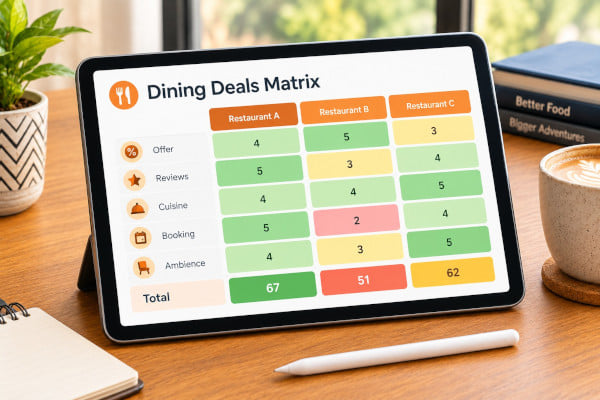
A decision matrix turns subjective impressions into a comparable score. The table below shows how to score three hypothetical shortlisted restaurants across the five criteria. Each criterion is rated 1 to 5, then multiplied by a weight the diner assigns based on personal priorities.
| Criterion | Weight | Restaurant A (score / weighted) | Restaurant B (score / weighted) | Restaurant C (score / weighted) |
| Offer value | 3 | 4 / 12 | 5 / 15 | 3 / 9 |
| Review quality | 4 | 5 / 20 | 3 / 12 | 4 / 16 |
| Cuisine fit | 3 | 4 / 12 | 4 / 12 | 5 / 15 |
| Reservation reliability | 3 | 5 / 15 | 2 / 6 | 4 / 12 |
| Ambience and occasion | 2 | 4 / 8 | 3 / 6 | 5 / 10 |
| Total | 15 | 67 | 51 | 62 |
In this example, Restaurant A scores highest despite not offering the deepest discount. Restaurant B wins on offer value alone but loses ground on reviews and booking reliability. The matrix makes that tradeoff visible.
Diners can adjust weights to match priorities. A budget-focused solo lunch might weight offer value at 5 and ambience at 1. A couple planning a date night in Mumbai might flip those weights. The framework stays the same; only the emphasis shifts.
How to use EazyDiner for this
EazyDiner is designed to surface the signals this matrix needs, all within a single discovery flow. Diners searching for dining deals near them on EazyDiner can filter by cuisine, location and offer type. Each restaurant listing shows ratings, menu highlights and available prepaid deals or dining discounts.
The table booking step is integrated into the same flow. Once a diner identifies a restaurant that scores well across the criteria, EazyDiner lets the diner confirm a reservation and, where applicable, lock in a prepaid deal in one session. That integration is what separates evaluated discovery from blind deal hunting.
EazyDiner Prime membership can add another layer of savings for frequent diners. Prime members access exclusive dining discounts on top of listed offers, which can shift the offer value score in the matrix without affecting the other criteria. The quality signals remain independent of the membership tier.
Common evaluation mistakes
Even with a framework, diners fall into predictable traps. Recognising these mistakes sharpens the evaluation process.
Anchoring on discount depth is the most common error. A 50 percent off headline grabs attention, but if the base price is inflated or the menu is limited, the real saving is smaller than it appears. Always check what the offer covers before scoring offer value.
Ignoring review recency is another pitfall. A restaurant that earned strong reviews two years ago may have changed chefs or ownership. Prioritise recent reviews when scoring review quality. EazyDiner's curated listings can help diners spot whether feedback is current.
Skipping the reservation step is a subtler mistake. Diners sometimes find a great deal, plan to walk in, and discover the restaurant is fully booked. Confirming a table through EazyDiner's booking system eliminates that risk and gives the restaurant advance notice to prepare for the diner's arrival.
Putting the framework into practice
Start by listing three to five restaurants from an EazyDiner search filtered by cuisine and location. Score each restaurant across the five criteria using the matrix. Compare totals. Book the winner through EazyDiner's table booking feature, locking in any prepaid deal or dining discount at the same time.
This approach takes only a few extra minutes, yet it shifts the decision from impulse to evidence. Diners who evaluate offers this way report fewer disappointing meals and more confidence that the savings are genuine. EazyDiner's combination of restaurant discovery, transparent offers and confirmed reservations makes the evaluation practical rather than theoretical.