
No Shows Hurt More When the Restaurant Has No System for Reconfirmation or Waitlist Recovery
An empty reserved table during peak hours represents direct revenue loss for restaurants
20 Nov, 2026 by Editorial Team
A single empty table during a Friday dinner rush can cost a restaurant more than the meal itself. The lost cover, the idle staff, the turned-away walk-in who saw a "fully booked" status online: these compound quickly. EazyDiner, through its Livetable restaurant SaaS, addresses the root cause. No shows hurt most when a restaurant has no system to reconfirm bookings or recover that table through a waitlist. Without those workflows, every unfilled seat is pure revenue leakage.
TL;DR - Summary
- Why do no shows matter?
Every unreconfirmed reservation that goes unfilled wastes a revenue slot, especially during peak hours when demand exceeds capacity. Restaurants without reconfirmation workflows absorb the full cost of that empty table.
- What is reconfirmation?
Reconfirmation is the process of contacting a guest before the reservation to verify attendance. Automated reconfirmation, such as the workflow available through Livetable by EazyDiner, can help reduce no show rates by flagging cancellations early enough to rebook the table.
- What is waitlist recovery?
Waitlist recovery means filling a cancelled or no show table by automatically offering the slot to the next guest in a digital queue. Without this step, the table stays empty even when other diners want the seat.
- How does Livetable help?
Livetable by EazyDiner is a restaurant SaaS platform designed to manage reservations, automate reconfirmation messages and maintain a live waitlist so restaurants can recover tables before the service window closes.
What no shows actually cost
No shows are not just an inconvenience. They represent a direct hit to a restaurant's bottom line. When a four-top sits empty for 90 minutes on a Saturday night, the restaurant loses the revenue from that table and the opportunity cost of turning away other guests.
The damage extends beyond a single meal. Kitchens prep ingredients based on expected covers. Staff are scheduled around projected demand. A cluster of no shows during a peak window can leave a restaurant overstaffed, overstocked and underperforming on the night that should carry the week's margins.
Restaurants in cities like Delhi NCR, Mumbai and Bangalore face this problem acutely during weekends and festival seasons, when demand is high but so is the likelihood of last-minute plan changes. Without a system to detect and respond to cancellations, the restaurant absorbs the full cost silently.
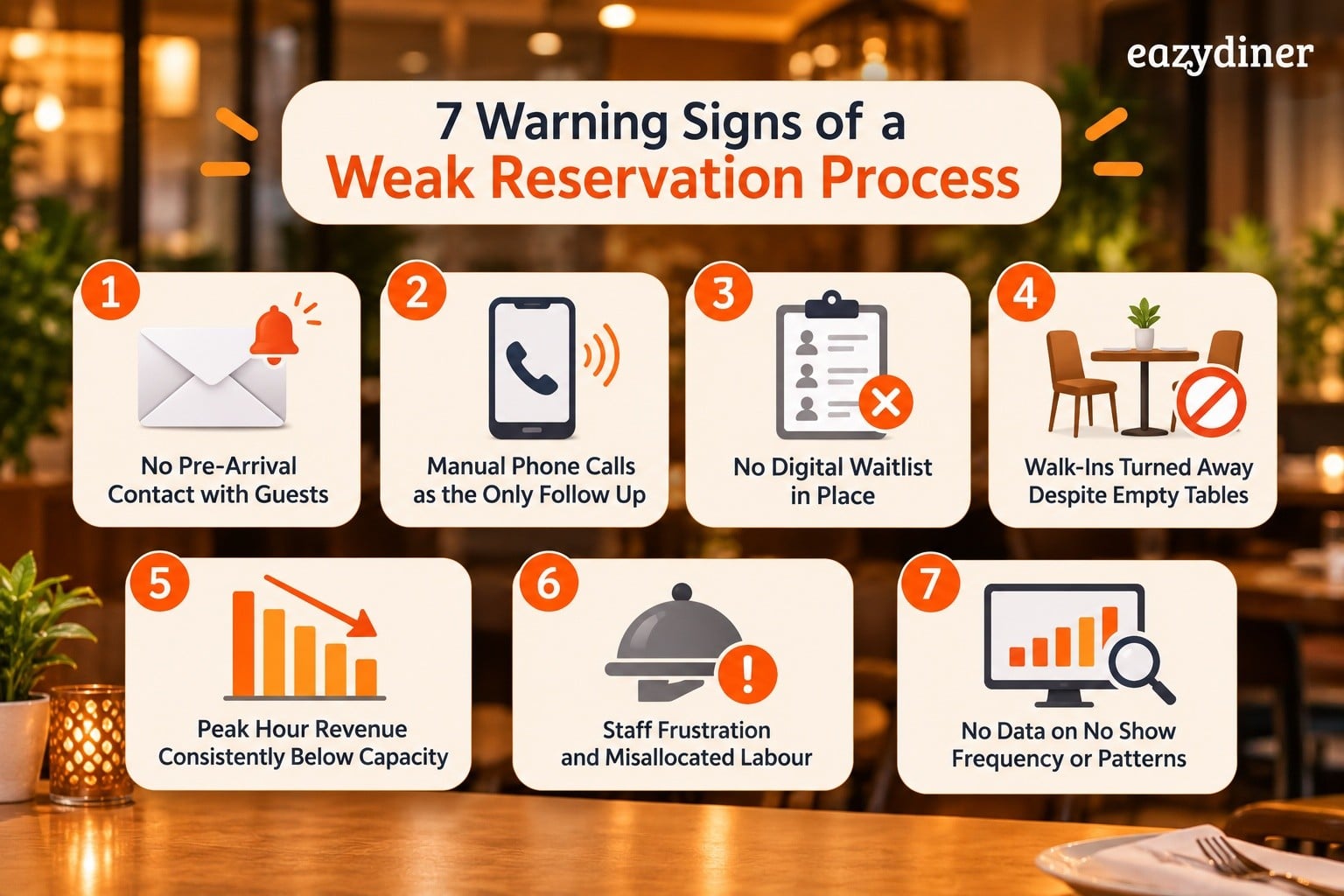
Warning signs of a weak reservation process
Not every restaurant recognises the symptoms until the damage is visible on the P&L. Below are the warning signs that a reservation process lacks the reconfirmation and recovery workflows needed to protect revenue.
1. No pre-arrival contact with guests
If the only communication a guest receives is the initial booking confirmation, the restaurant has no way to gauge whether the guest still plans to arrive. A reservation made three days in advance can go stale. Plans change, and without a reconfirmation touchpoint, the restaurant discovers the no show only when the table sits empty past the booking time.
2. Manual phone calls as the only follow up
Some restaurants rely on hosts calling each reservation individually. This approach does not scale during busy periods. A host managing a 60-cover evening service cannot realistically call 25 reservations while also seating walk-ins and coordinating with the kitchen. Calls go unmade, and no shows go undetected.
3. No digital waitlist in place
When a no show is finally identified, the next question is: who gets the table? Restaurants without a waitlist system have no queue of interested diners ready to fill the gap. The table stays empty because there is no mechanism to offer the slot to someone else in time.
4. Walk-ins turned away despite empty tables
This is the most visible symptom. A restaurant shows "fully booked" on its reservation system, turns away walk-in guests, and then watches reserved tables go unclaimed. The mismatch between displayed availability and actual occupancy is a direct result of missing reconfirmation logic.
5. Peak hour revenue consistently below capacity
If a restaurant seats 80 covers but consistently bills for 65 during Friday and Saturday dinner services, the gap often traces back to no shows that were never recovered. Over weeks and months, that 15-cover shortfall compounds into significant lost revenue.
6. Staff frustration and misallocated labour
Servers assigned to sections with no show tables have less to do, while other sections may be overloaded with walk-ins squeezed into remaining seats. The imbalance creates service inconsistencies and affects staff morale, particularly in restaurants where tips depend on covers served.
7. No data on no show frequency or patterns
Restaurants that lack reservation management software often cannot answer basic questions: what is the no show rate on weekday lunches versus weekend dinners? Which booking channels produce the most no shows? Without this data, the restaurant cannot target interventions or adjust overbooking buffers intelligently
Why reconfirmation changes the equation
Reconfirmation is the single most effective step a restaurant can take to reduce no show damage. The concept is straightforward: contact the guest before the reservation, ask whether the booking still stands, and act on the response.
Automated reconfirmation, the kind built into Livetable by EazyDiner, sends a message to the guest a set number of hours before the reservation. If the guest confirms, the table is locked. If the guest cancels or does not respond within a defined window, the table is released back into available inventory
This workflow matters because it shifts the moment of discovery. Instead of learning about a no show at 8:15 PM when the guest fails to arrive, the restaurant knows by 4 PM that the table is free. That four-hour window is enough to rebook the slot, either through the waitlist or by opening the table for new reservations on EazyDiner.
Reconfirmation also changes guest behaviour. When diners know they will be asked to confirm, they are more likely to cancel proactively rather than simply not showing up. The act of asking creates a small but meaningful accountability loop.
How waitlist recovery fills the gap
Reconfirmation identifies the problem. Waitlist recovery solves it. A digital waitlist is a queue of guests who want a table but could not get one at their preferred time. When a reconfirmed cancellation or a detected no show frees a slot, the system can automatically notify the next guest on the waitlist.
Livetable by EazyDiner is designed to maintain this kind of live waitlist. When a table opens up, the platform can offer the slot to waitlisted guests in order, giving each a short window to accept before moving to the next person. The result is that tables freed by cancellations or no shows are filled before the service window closes.
Without waitlist recovery, even a restaurant that reconfirms bookings still loses revenue on late cancellations. The reconfirmation catches the cancellation, but without a queue of ready diners, the table has nowhere to go. The two workflows, reconfirmation and waitlist recovery, work as a pair.
What reservation management software should do
Restaurants evaluating reservation management tools should look for specific capabilities that address the no show problem directly. Not every booking system includes reconfirmation or waitlist logic. The features that matter most for no show prevention include automated reconfirmation messaging, a digital waitlist with notification capability, table utilisation tracking and no show analytics.
Livetable by EazyDiner is built as a restaurant SaaS platform that combines reservation management with these operational workflows. For restaurants in India, where peak dining windows are narrow and demand can be intense, having these capabilities in a single system can help reduce the revenue impact of no shows.
Reservation management is not just about accepting bookings. It is about managing the full lifecycle of a reservation, from confirmation through reconfirmation to recovery when things do not go as planned. Restaurants that treat reservation management as a passive intake process will continue to absorb no show losses. Restaurants that treat reservation management as an active operational workflow, supported by software like Livetable, are better positioned to protect their revenue during every service.
If empty tables during peak hours are a recurring problem, the issue is likely not demand. The issue is the system, or the absence of one. EazyDiner's Livetable gives restaurants the tools to reconfirm, recover and fill every seat that matters.