How To Choose Between Prepaid Deals, Live Offers and Payment Offers in India
A visual framework for picking the right EazyDiner deal type before dining out
28 Nov, 2026 by Editorial Team
Every restaurant bill in India comes with a quiet question: could you have paid less? Between prepaid dining deals, live offers at the table and payment offers tied to your card or wallet, the answer is almost always yes. The real challenge is knowing which format saves the most for your specific meal. EazyDiner structures all three deal types on a single platform, but choosing between them still trips up most diners. This decision model removes the guesswork.
TL;DR - Summary
- What are prepaid deals?
Prepaid deals on EazyDiner let you pay a fixed amount before dining and receive a higher value at the restaurant. Because the commitment is upfront, the discount percentage is typically the steepest of the three formats.
- What are live offers?
Live offers are percentage discounts visible when you book or walk in. They require no advance payment, so they suit diners whose plans may change. The trade-off is a smaller saving compared to prepaid.
- What are payment offers?
Payment offers are cashback or discounts triggered when you settle the bill through a specific bank card, UPI handle or wallet. They stack on top of the meal price and sometimes combine with other deal types.
- Which deal type saves the most?
Prepaid deals generally deliver the deepest per rupee saving when your dining plan is confirmed. Payment offers add incremental value on top, while live offers protect flexibility for uncertain plans.
- How do you choose?
Match the deal type to three variables: bill size, dining certainty and redemption conditions. A decision matrix in this article scores each variable so you can pick the right format in under a minute.
Why deal formats confuse diners
Indian restaurant platforms present savings under labels such as "prepaid," "flat off," "cashback" and "bank offer." Each label hides a different mechanic. Prepaid deals lock in value before the meal. Live offers discount the bill at the point of booking or arrival. Payment offers reward a particular payment method after the meal is ordered.
The confusion grows because these formats overlap. A diner on EazyDiner might see a prepaid deal, a live discount and a credit card cashback offer for the same restaurant on the same evening. Without a framework, most people default to whichever number looks largest, even when a different combination would save more.
How each deal type works
Prepaid deals on EazyDiner
A prepaid deal asks you to pay a set amount, say ₹500, through EazyDiner before you visit the restaurant. In return, you receive a voucher worth more, perhaps ₹1,000, to redeem against your bill. The saving is baked into the price gap between what you pay and what you receive.
This format works well when you are certain about the restaurant, the date and a rough bill size. The discount is locked the moment you purchase. Cancellation and refund terms vary by deal, so reading the fine print matters. EazyDiner lists these conditions on each deal page.
Live offers
Live offers appear as a percentage or flat rupee discount on the bill. They activate when you book a table through EazyDiner or, in some cases, when you walk in. No advance payment is needed. The restaurant honours the discount at checkout.
Because the platform bears less commitment risk, live offer discounts tend to be shallower than prepaid deals. Their strength is flexibility. Plans change, group sizes shift, and a live offer does not penalise you for cancelling or switching restaurants.
Payment offers
Payment offers are tied to a bank, card network, UPI app or digital wallet. When you pay the restaurant bill using the qualifying method, you receive cashback, reward points or an instant discount. EazyDiner surfaces these through its PayEazy checkout integration, making the eligible offers visible before you pay.
Payment offers sometimes combine with prepaid or live deals, creating a stacked saving. However, each payment offer carries its own minimum spend, maximum cashback cap and validity window. Ignoring these caps is the most common reason diners feel shortchanged after a meal.
Decision matrix: scoring each variable
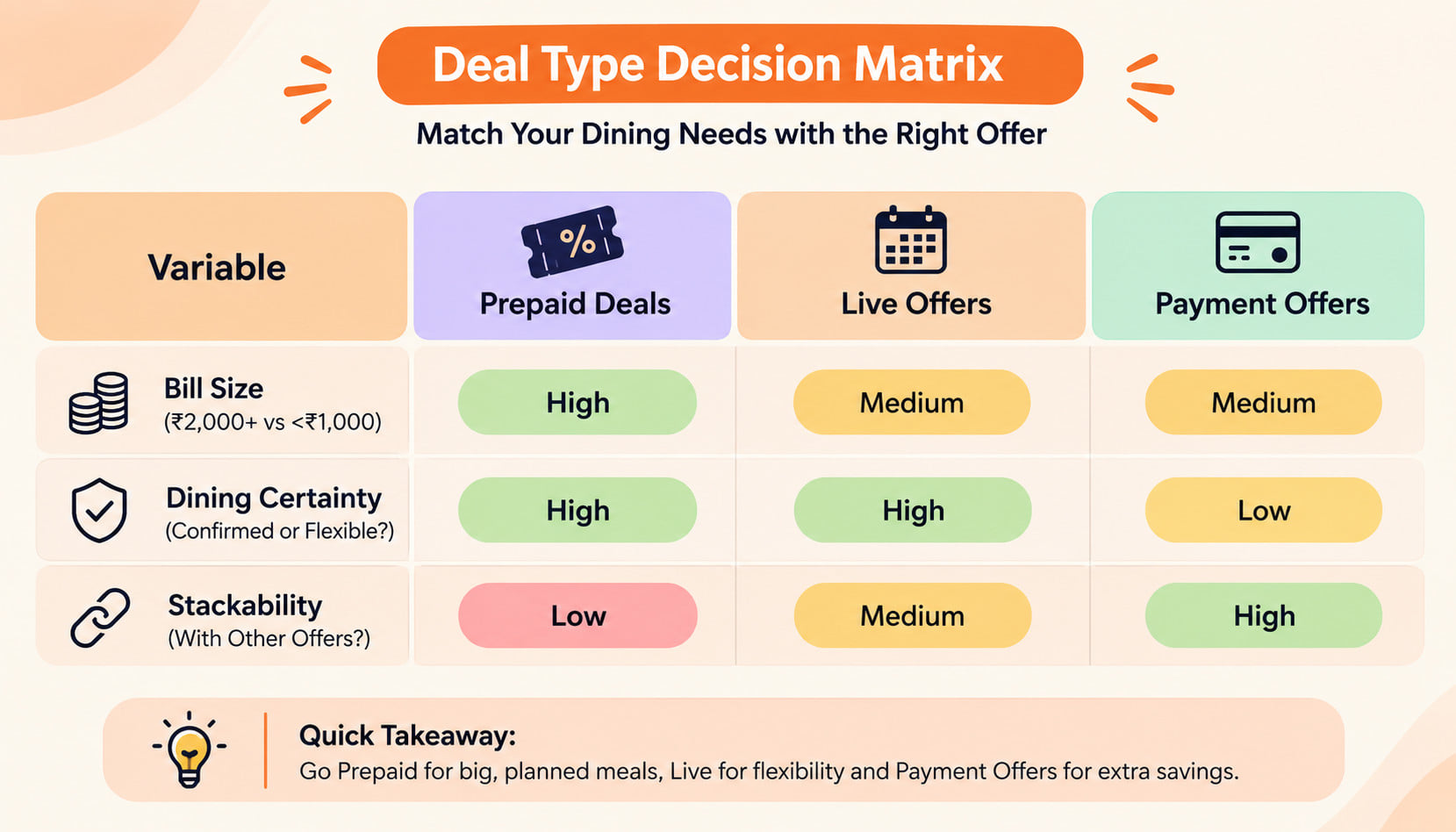
Three variables determine which deal type is optimal for a given meal: bill size, dining certainty and redemption conditions. The table below scores each deal type against these variables on a simple scale of low, medium and high.
| Variable | Prepaid Deals | Live Offers | Payment Offers |
| Best for large bills (₹2,000 and above) | High: the fixed price gap yields a larger absolute saving on bigger tabs | Medium: percentage discounts scale, but caps may limit the total | Medium: cashback caps often plateau around ₹300 to ₹500 |
| Best for small bills (under ₹1,000) | Low: minimum voucher values may exceed the meal cost | High: a flat 15 to 25 per cent off a small bill is simple and sufficient | Low: minimum spend thresholds may not be met |
| Dining certainty required | High: you pay before dining, so cancellation carries risk | Low: no upfront cost, easy to cancel or change | Low: triggered only at the point of payment |
| Ease of redemption | Medium: requires showing the voucher at the restaurant | High: discount applies automatically through the booking | Medium: must use the correct card or wallet at checkout |
| Stackability with other offers | Low: prepaid deals usually cannot combine with live discounts | Medium: may combine with payment offers at select restaurants | High: can often layer on top of a live offer or base bill |
Read the table row by row for your situation. If your bill is large and your plan is confirmed, prepaid deals score highest. If your plan is tentative or the bill is modest, live offers win on flexibility. Payment offers add the most value as a secondary layer, not a primary strategy.
Step by step: picking the right deal
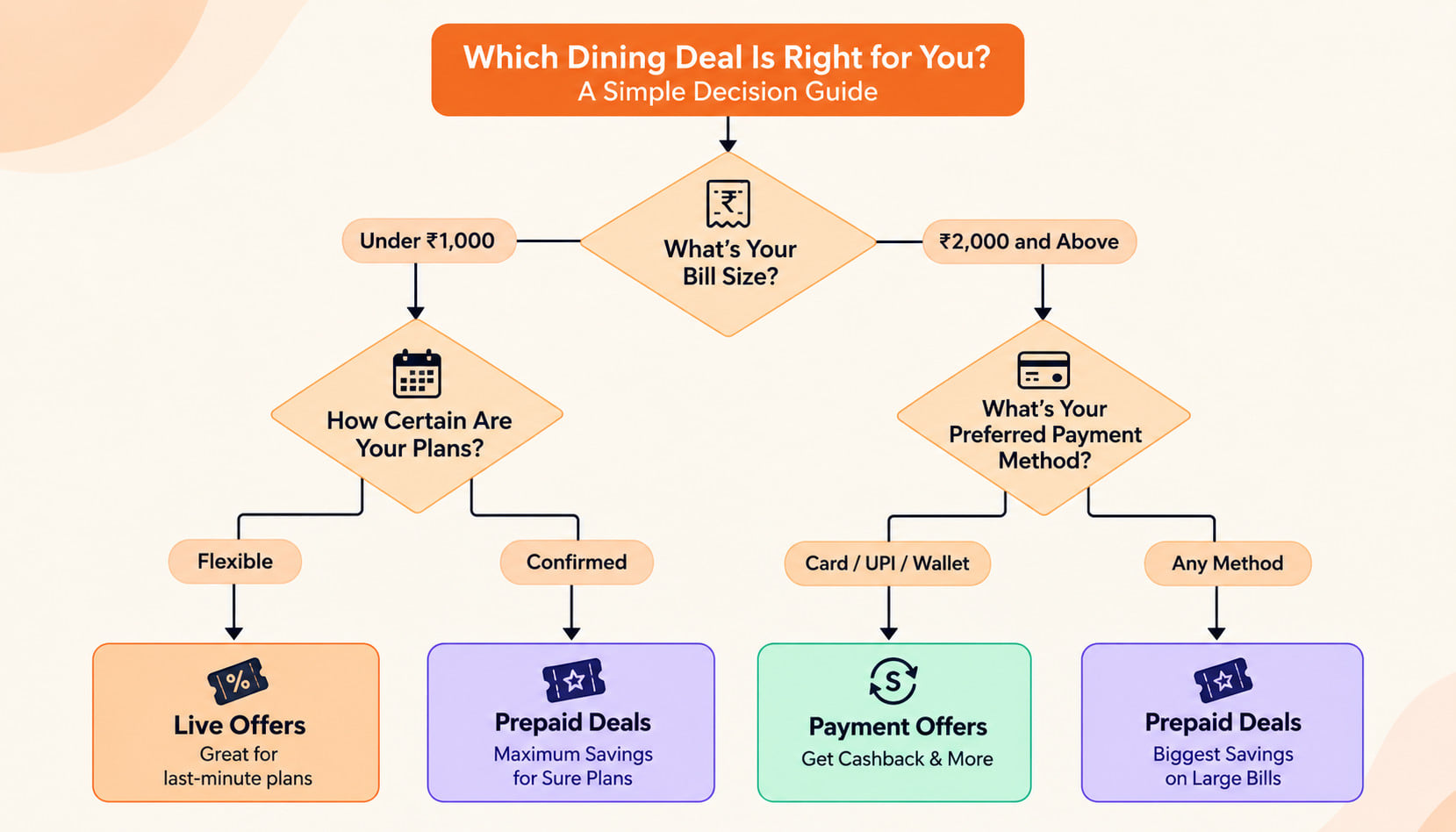
Start with certainty. Ask yourself whether the restaurant, date and approximate group size are locked. If yes, check EazyDiner for a prepaid deal at that restaurant. Compare the pay versus receive gap to the live offer percentage. Whichever yields a higher absolute saving on your expected bill is the better pick.
If your plan is flexible, default to a live offer. Book through EazyDiner to lock in the discount, but know you can cancel without losing money. Before you pay the final bill, check PayEazy for a qualifying payment offer. Stacking a live discount with a card cashback is the simplest way to maximise savings without any prepaid commitment.
For special occasions where the bill is likely to cross ₹3,000 to ₹5,000, prepaid deals almost always outperform. The fixed price gap on a large voucher can translate to savings that no percentage discount or cashback cap can match. Treat prepaid as the power move for confirmed, high value meals.
Common mistakes to avoid
Choosing by headline number alone is the biggest error. A "50 percent off" live offer sounds better than a "pay ₹1,500, get ₹3,000" prepaid deal until you realise the live offer caps at ₹500 while the prepaid deal saves ₹1,500 outright. Always convert the deal into an absolute rupee saving against your expected bill.
Ignoring payment offer caps is the second mistake. A "20 percent cashback" offer with a ₹200 cap saves exactly ₹200 regardless of whether your bill is ₹1,000 or ₹5,000. Check the cap before assuming the percentage applies to the full amount.
Forgetting validity windows costs diners too. Prepaid vouchers and payment offers both carry expiry dates. Buying a prepaid deal for "sometime next month" without checking the redemption window can turn a saving into a loss.
When to combine deal types
EazyDiner allows stacking at select partner restaurants. The most common combination is a live offer plus a payment offer through PayEazy. The live offer reduces the bill, and the payment offer returns cashback on the reduced total. This combination works best for mid-range bills where neither deal type alone delivers a dramatic saving.
Prepaid deals rarely stack with live offers because the voucher already embeds a discount. However, some restaurants allow a payment offer on the remaining balance after the voucher is applied. Check the deal terms on EazyDiner before assuming any combination is valid.
EazyDiner Prime members may access deeper prepaid deals or exclusive live offers not visible to non members. If you dine out frequently, the membership can shift the decision matrix further toward prepaid and stacked formats because the baseline discounts start higher.
Choosing between prepaid deals, live offers and payment offers does not require guesswork. Match your bill size, certainty and payment method to the matrix above, convert every deal into an absolute rupee saving, and check stacking rules on EazyDiner before you pay. The right deal type is always the one that fits your specific meal, not the one with the biggest headline number.