
What Makes a Dining Payment Offer Stackable in India?
Understanding when dining offers can combine to maximise savings
28 Nov, 2026 by Editorial Team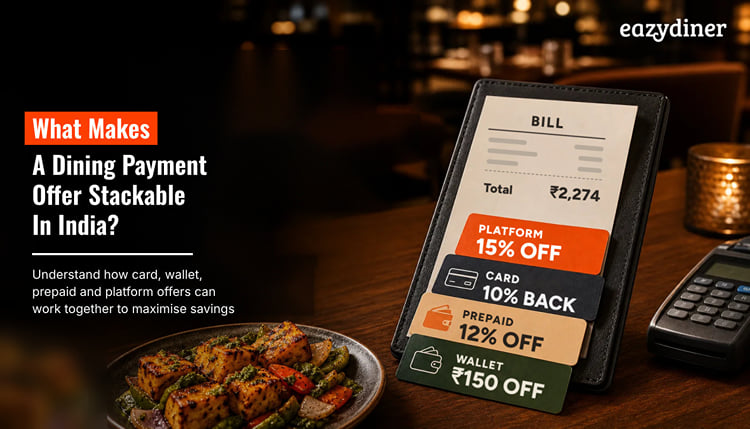
Stacking dining offers sounds simple until the bill arrives and only one discount applies. Indian diners who want to combine a card promotion with an app discount or a prepaid deal need to understand what makes these offers stackable. EazyDiner addresses this question directly, helping value-conscious diners plan savings before they book or pay.
TL;DR - Summary
- What does stackable mean?
A stackable dining offer is one that can be combined with another promotion at the same restaurant during the same transaction. Not all offers allow this; terms set by the restaurant, card issuer or platform determine whether layering is permitted.
- Which offer types can stack?
Platform discounts (such as EazyDiner deals), card issuer cashback and prepaid dining deals each carry separate terms. When their conditions do not conflict, diners can sometimes apply more than one benefit to a single bill.
- How to check before paying?
Read the terms on each offer for exclusion clauses like "not valid with other promotions." EazyDiner displays offer conditions on the restaurant listing page, so diners can verify stackability before completing a booking or prepaid purchase.
What makes an offer stackable?
A dining payment offer becomes stackable when its terms do not explicitly exclude other promotions. Three conditions typically need to align. The restaurant must accept combined discounts. The payment partner (bank or wallet) must not restrict its cashback to standalone use. The platform facilitating the booking must permit layering.
For example, a credit card issuer may offer 15 percent cashback on dining transactions above a threshold. If the restaurant also runs a flat discount through EazyDiner, the two can stack only when neither set of terms bars the other. The moment one party adds an exclusion clause, stackability breaks.
Prepaid deals on EazyDiner work differently from card offers. A prepaid deal locks in a discount at the time of purchase. Whether a card cashback applies on top depends on the card issuer's terms for that merchant category. Diners should treat each layer as a separate contract with its own fine print.
Common stacking scenarios in India
Indian diners encounter several typical combinations. A platform discount plus a bank card cashback is the most common pairing. EazyDiner restaurant listings often show a deal (say, a percentage off the total bill) alongside a note about eligible card offers. When both are active and neither excludes the other, the diner can benefit from both.
Another scenario involves EazyDiner Prime membership benefits combined with a prepaid deal. Prime members receive additional savings at partner restaurants. If the prepaid deal's terms permit use alongside membership benefits, the two can layer. EazyDiner's listing page for each restaurant clarifies whether Prime benefits apply on top of a prepaid offer.
A less common but valuable combination is a wallet cashback (such as a UPI offer) stacked with a platform discount. Wallet promotions are issued by the payment provider, not the restaurant. Because they operate at the payment layer rather than the billing layer, they sometimes coexist with restaurant-level discounts. However, diners should confirm this on the wallet provider's offer page before assuming stackability.
How to verify before you pay
Checking stackability takes less than a minute when you know where to look. On EazyDiner, open the restaurant's listing and tap the offer details. Look for phrases like "cannot be combined with other offers" or "valid as standalone offer only." If no such exclusion appears, the offer is designed to coexist with other eligible promotions.
For card offers, visit the issuing bank's dining offers page or the card's app notification. Banks typically list exclusions under "terms and conditions." If the card offer says "valid on net bill after all discounts," the cashback can apply even after a platform discount reduces the total.
Diners who use EazyDiner's PayEazy checkout can see applicable offers consolidated at the payment step. PayEazy displays the final amount after platform discounts, making it easier to judge whether a card or wallet cashback will apply on the remaining total. This transparency helps diners avoid surprises at the table.
Stackable offers reward diners who read the fine print before booking. EazyDiner simplifies this by surfacing offer terms on each restaurant listing, so the savings calculation happens before the meal, not after. For diners in India who want to maximise value, confirming stackability is a small step that can meaningfully reduce the final bill.